Blog · Coffee · Leer en español · Ler em português
Why your coffee tastes bitter (or sour, or watery) and what to change
Coffee tastes bitter, sour or watery for three different reasons. How to tell which one you got and what to change, one thing at a time, scale or no scale.

Coffee almost always tastes bitter because the water pulled too much out of it: the grind was too fine, the coffee spent too long in contact with the water, or the water was too hot. It tastes sour for the opposite reason, and watery for a different one, which is too little coffee for that much water. Below is how to tell which of the three happened to you and what to change, one thing at a time.
Bitter, sour and watery are three different problems
Most of us lump all three complaints together (“it came out bad”), and that's why we never fix any of them. The difference comes down to a single idea: water doesn't pull everything out of the coffee at once. The fruity, acidic notes come out first, then the sweet ones and the balance, and the bitterness last (that's the order a Perfect Daily Grind guide gives, and it's where I'm taking this from).
With that in mind, the three bad cups explain themselves. If the water ran through too fast or spent too little time with the coffee, it got as far as the acids and never reached the sweetness, and the cup comes out sour, the kind that makes you pucker. If it stayed too long, it kept pulling until it reached the bitterness. It's like a tea bag forgotten in the cup: at two minutes it's fine, and at ten nobody can drink it. And if you used too little coffee for the water you poured in, the cup comes out watery even if everything else is spot on, because what went wrong there is how much coffee there was, not how much got pulled out of it.
What to change, depending on what you taste
The rule is to change one thing at a time. If you change three, you won't know which one it was.
- If it's bitter, grind a little coarser. If you buy your coffee pre-ground, shorten the brew time or let the water sit for a minute after it boils. The guides talk about 91 to 96 °C (195 to 205 °F), not water at a rolling boil.
- If it's sour or sharp, grind a little finer or give it more time.
- If it's watery, use more coffee or less water. The grind won't fix this one.
- If it's bitter and sour at the same time, suspect an uneven grind, with dust and big chunks in the same spoonful.
This isn't a beginner's problem. On Home-Barista, an English-language coffee forum, someone wrote that their V60 went from “bitter as hell” to “thin and watery with nothing in it.” And on Reddit, a Brazilian asked, after trying three grinder settings with a moka pot, what they were doing wrong, because the coffee kept coming out “ou amargo ou meio azedo” (either bitter or kind of sour). The answer that comes up most in those threads is the same one as above: “change just one parameter at a time.”
At home I have one of those grinders that let you adjust the grind (the coffee drops, already ground, into a container; it's not a blade grinder, the kind that spins and keeps scorching the coffee in the same spot). You don't have to start there, but it's worth knowing why it matters: the same publication says grind uniformity is, by far, the factor that matters most.
What a French press with no scale taught me
I learned this the hard way. I had a French press at the office and it took me a while to get the hang of it, because I had no scale there and nothing decent to measure with, and a lot of the time my coffee came out watery. What was I doing differently from one day to the next? I had no way of knowing, and that was the real problem. Without measuring, there's no way to repeat the good cup or fix the bad one.
If you want a starting point for the press, that guide suggests 35 g (1.2 oz) of coffee to 475 ml (16 fl oz) of water, a coarse grind (similar to coarse salt) and four minutes. And with no scale? Always use the same spoon and the same cup (it won't be exact, but it'll be the same every day, which is what lets you compare). That last part doesn't come from any guide; it's what would have helped me in that office.
Not every coffee has to be a ceremony, either. My everyday one comes out of a perfectly ordinary drip coffee maker, which I program the night before, with water in the tank and ground coffee in the filter, so I find it freshly made when I step out of the shower. I also have a press, a moka pot and a handmade ceramic dripper, but that's my daily coffee.
Writing down what you did, which almost nobody does
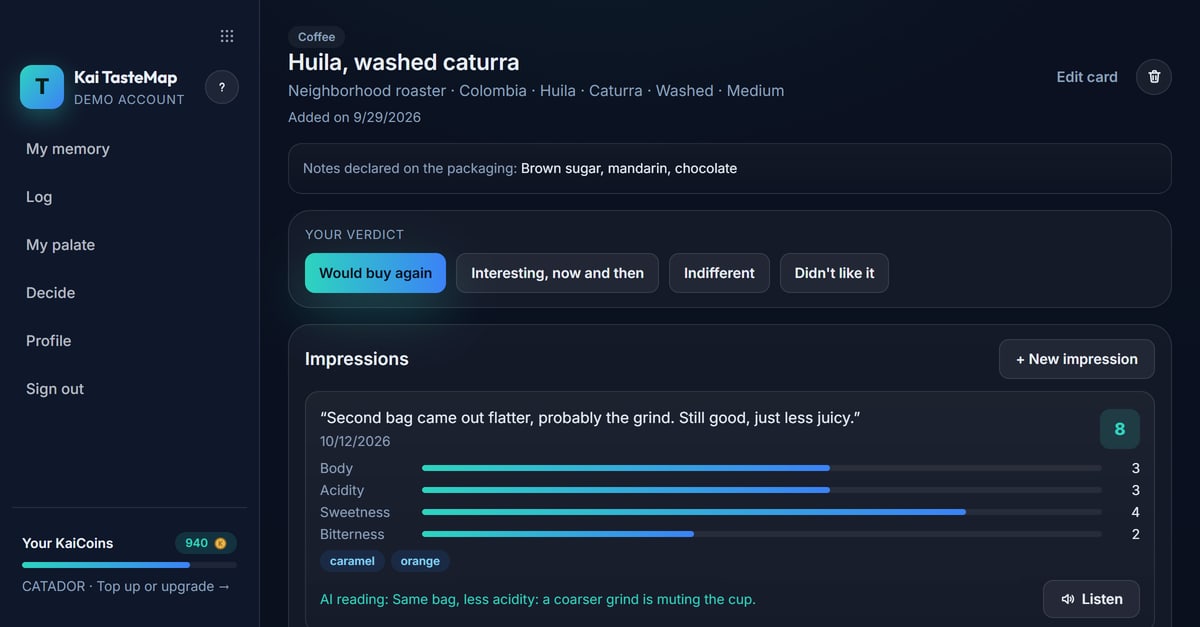
The rules above fit on a napkin. The hard part is remembering what you did yesterday (how many spoonfuls, how long, how fine), and without that every cup is the first one. I built Kai TasteMap because I forget the coffees I like, so take it with the bias of the person who made it: each coffee's card keeps the brew (method, dose, water, grind, temperature and time), you can mark the one that came out well so you can repeat it, and when one goes wrong you tell it what happened in your own words and it suggests a single change, with the reason behind it and a plan B. A single change, same as above.
I'm left with one doubt. All of this assumes that bitter is a mistake, and I'm not so sure: there are people who enjoy the same strong, bitter coffee they've always had, and I don't see why their taste should need correcting. In one of those threads, someone said they tried a scale, their own grinder and a filter, and that in the end “it still tasted like coffee to me.” Maybe the perfect cup in the guides is only a starting point. How do you like your coffee, and when was the last time it came out that way?
See you next time. Mauro Z.