Blog · Wine · Leer en español · Ler em português
Types of wine: a short map for choosing without being a wine person
The types of wine in four questions: color, sweetness, bubbles and body. A short map for placing any bottle, and what no map can tell you.

The types of wine make sense with four questions: what color it is (red, white or rosé), how sweet it is (from dry to sweet), whether it has bubbles and how heavy it feels in your mouth (from light to full-bodied). With those four you can place almost any bottle on the shelf, without memorizing names. What no classification tells you is which one you like. That's what the last part is about.
The color comes from the skin, not the pulp
Almost all grapes, dark-skinned ones included, give a colorless juice. Red wine is red because that juice ferments together with the skins, which are what carry the color (and the tannins, which come up again further down). White is made without that contact and rosé with very little, usually two or three days, and the longer it spends with the skins, the more color it picks up. That's why a rosé usually isn't a blend of red and white, which is the first thing you'd imagine.
Dry doesn't mean rough
“Dry” only means the wine has almost no sugar left. The OIV (the international wine body) calls a wine dry when it has up to 4 grams of sugar per liter, and from there it climbs through medium dry and semi-sweet to sweet, which starts at 45. What confuses people is that many dry reds also leave a rough feeling, as if your mouth had run out of saliva, and that one comes from the tannins, not from the lack of sugar. They're two different things. Which of the two is the one that bothers you, or the one you like? Knowing that saves more failed purchases than memorizing twenty names.
Bubbles, and wines with added alcohol
Two families fall outside that count. Sparkling wines (champagne and cava are two of the best known) have gas that came from the wine itself during a fermentation, not injected gas. And fortified wines are wines like port and sherry that had grape spirit added to them, which is why they sit between 15 and 22% alcohol, well above a table red.
Body, with three wines as examples
Body is the hardest thing to explain and the easiest to feel: it's how heavy the wine feels in your mouth, more or less the difference between skim milk and whole milk. I place it by thinking of people, because that's how I choose when I'm bringing a bottle. For someone who enjoys an intense wine I bring a cabernet, for someone who prefers something smooth, the kind that goes down easy, a pinot noir, and for someone who tells me they like sweet ones I track down a late harvest (which is truly sweet, not just “smooth”). The same goes for whites, from the light, fresh ones to the ones that fill your mouth more.
What the map doesn't tell you
I've been learning about wine for twenty years. I started out going to every free tasting I could find, later I studied and read a bit more, and for twelve years I've been married to a sommelier who trained in Argentina (so in my house, she's the one who knows). Even with all that, in front of the shelf I still choose like anyone else: by what I know, by what I feel like trying and, above all, by price. I almost never check recommendation sites or apps; I'd rather take a chance.
I'm not the only one who chooses that way. On Reddit, someone asked in December 2024 how everyone else chooses in front of the supermarket shelf (“Do you go by grape, region, producers you know, google, etc”), and on an Argentine forum in 2023 a supermarket rule was going around: that the best ones are on the shelves “de la altura de los ojos hacia arriba” (from eye level up). I don't know if the rule works, but it says a lot about how we choose when nobody gave us a map.
The trouble with taking a chance is that afterwards you have to remember. I remember wine better than coffee or beer, but I end up going back to the usual ones, and of the rest all I'm left with is “I know I tried one, but I can't remember what it was called.” Then I don't see it on the shelf again and I forget it completely. Sound familiar? In May 2026, someone from Colombia was asking for help on Reddit to find “uno dulcesito que me impresionó” (a sweet little one that impressed me), and couldn't remember its name or whether it was a red or a rosé.
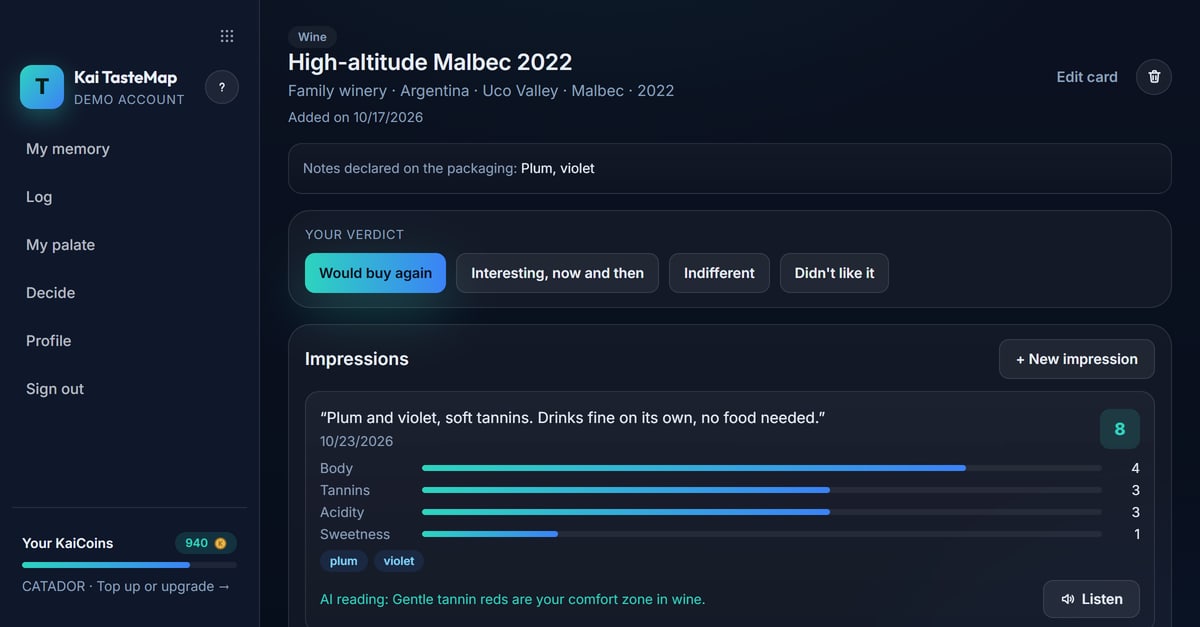
That's why I built Kai TasteMap (take it with the bias of the person who made it). You log what you taste with a photo of the label and what you thought of it, in your own words, and once there are several entries it builds a map of your palate: what you rate highest, and where what you believe you like doesn't match what you rate. In front of a wine list or a shelf, you take a photo and it ranks the options against that profile, with the reason behind each one. I'm only just starting to fill mine in, so I still don't know what it's going to say about me.
The question I'm left with is whether a map is any use before you've tasted anything. I think it works like the map of a city you don't know: it keeps you from getting lost, but it doesn't tell you which street you're going to like (you only find that out by walking). What was the last wine that surprised you, and do you still remember what it was called?
See you next time. Mauro Z.