Blog · Beer · Leer en español · Ler em português
Types of beer: the styles, explained by what you taste
Types of beer come from two families, lager and ale, and three dials: bitterness, malt and alcohol. A guide to reading the chalkboard at a bar.

Almost all types of beer come from two families, lager and ale, which differ in their yeast and in the temperature they ferment at, not in their color. Within each one, what changes from one style to the next is three things you can taste: how bitter it is, what the malt tastes like (from bread to coffee) and how much alcohol it has. That's enough to read the chalkboard at a bar without knowing the names.
Lager and ale: the difference is in the yeast
Lager ferments cold and slow, with yeasts that work at the bottom of the tank, and is then stored for a while, also cold (the word comes from the German lagern, to store). Ale ferments warmer, usually between 15 and 24 °C (59 to 75 °F), with yeasts that rise to the surface. There's a third branch, a much smaller one, which is spontaneous fermentation: beers like the Belgian lambics, which ferment with wild yeasts and are where a good share of the sours come from.
In the glass, that shows less than you'd think. What really changes the beer in front of you is the three dials further down, and that's why there are lagers and ales in almost every color and flavor.
Color doesn't tell you the flavor, or the strength
The color comes from the malts, especially the more heavily roasted ones. “Pale, amber and dark” works for ordering, but not for knowing what you're about to drink. The BJCP style guidelines, the ones competition judges use, show it with two examples: an Irish stout is black, tastes roasted (often a lot like coffee) and has between 3.8 and 5% alcohol, while a Belgian tripel is golden and runs from 7.5 to 9.5%. The black one is the lighter of the two. And there are black lagers, like the German schwarzbier, so color doesn't tell you the family either.
Three dials: bitterness, malt and alcohol
- Bitterness comes from the hops and is measured in IBU. To give you a scale: the same guidelines put an American light lager between 8 and 12, a German pilsner between 22 and 40 and an American IPA between 40 and 70.
- Malt runs from the taste of bread and biscuit in pale beers to roast, like coffee or chocolate, in dark ones.
- Alcohol is measured in ABV, the percentage by volume printed on the label. A light lager sits between 2.8 and 4.2%, and an American IPA between 5.5 and 7.5%.
A word of warning about IBU, which is the most misunderstood number. On Reddit, someone said a 42 IBU IPA seemed almost too bitter to them and that they loved another one at 72, and someone else replied that, as a guide to what you actually taste, “IBUs are basically meaningless.” I don't know enough to settle that argument, but I'll hold on to the warning: the number places one beer relative to another, it doesn't describe what you're going to taste.
The names you'll see most
- Pilsner: a pale, dry, bitter lager with a hop aroma. It's the grandmother of almost every mass-market pale lager, which are milder versions of it.
- IPA: a pale ale that's decidedly hoppy and bitter, and moderately strong. It's the flagship style of craft beer.
- Stout and porter: dark, with a roasted flavor. Being black doesn't make them strong.
- Wheat beer: pale, refreshing and highly carbonated. German weissbier has a banana-and-clove profile that comes from its yeast, not from added fruit.
- Sours: lambics and their relatives. If you've never tried one, the first one is a surprise.
What I know about beer, and what I don't
Of the three worlds on this blog (coffee, wine and beer), beer is the one I know least about, at least compared with the other two. I like it, and I follow it closely. I understand how it's made, I can tell when one has a flaw and I can have an opinion about the foam, but one of my good friends is a master brewer, and that makes it very clear to me what really knowing looks like. My thing is trying them: pale, dark, heavy, light, and if someone tells me one has soursop in it, that one too. I like trying things. And when I choose, I go for the bitter ones, well before the very mild or light ones.
What always happens to me is that I can't remember which one I liked. With craft beers it's worse than with wine, because when you go back to the same place the ones you tried are gone and there are new ones, and the photos I take of them end up lost in my phone's gallery. What's the point of understanding the styles if later I can't remember which of the three IPAs was the good one?
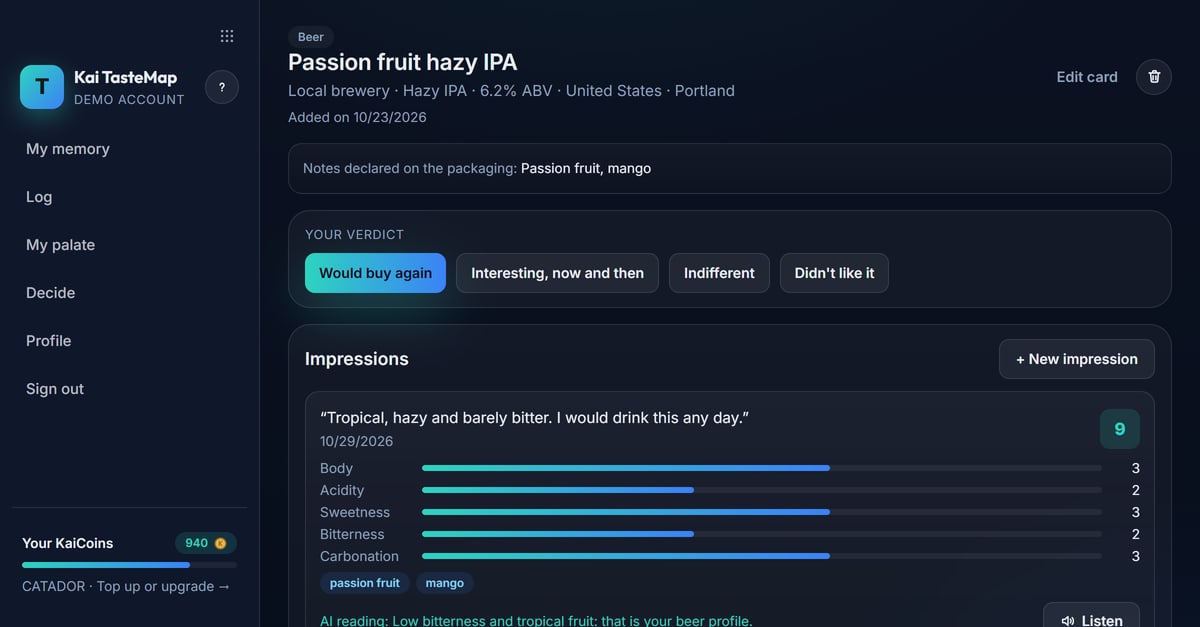
That's what I built Kai TasteMap for (take it with the bias of the person who made it). You take a photo of the label or the can and the card gets filled in with the brewery, the style and the alcohol, you give it a score and say what you thought of it, and the next time you have one in your hand you ask it, with another photo, whether you've already tried it. Once several are logged, it builds the map of what you really rate highest, which doesn't always match what you swear you like. I'm only just starting to fill mine in.
I don't know whether knowing the styles makes you like a beer more, or just makes you order better. I suspect it's the second, and that's enough for me. What's the style you always go back to, and which one did you try once and never again?
See you next time. Mauro Z.